Under Pressure
The Discovery
My mother collects Temptations stoneware—vibrant, patterned dishes that deserve to be seen, not buried in dark cabinets where only she knows they exist. Over time, her collection had outgrown her kitchen. Even her finest pieces were stacked behind closed doors, hidden from view.
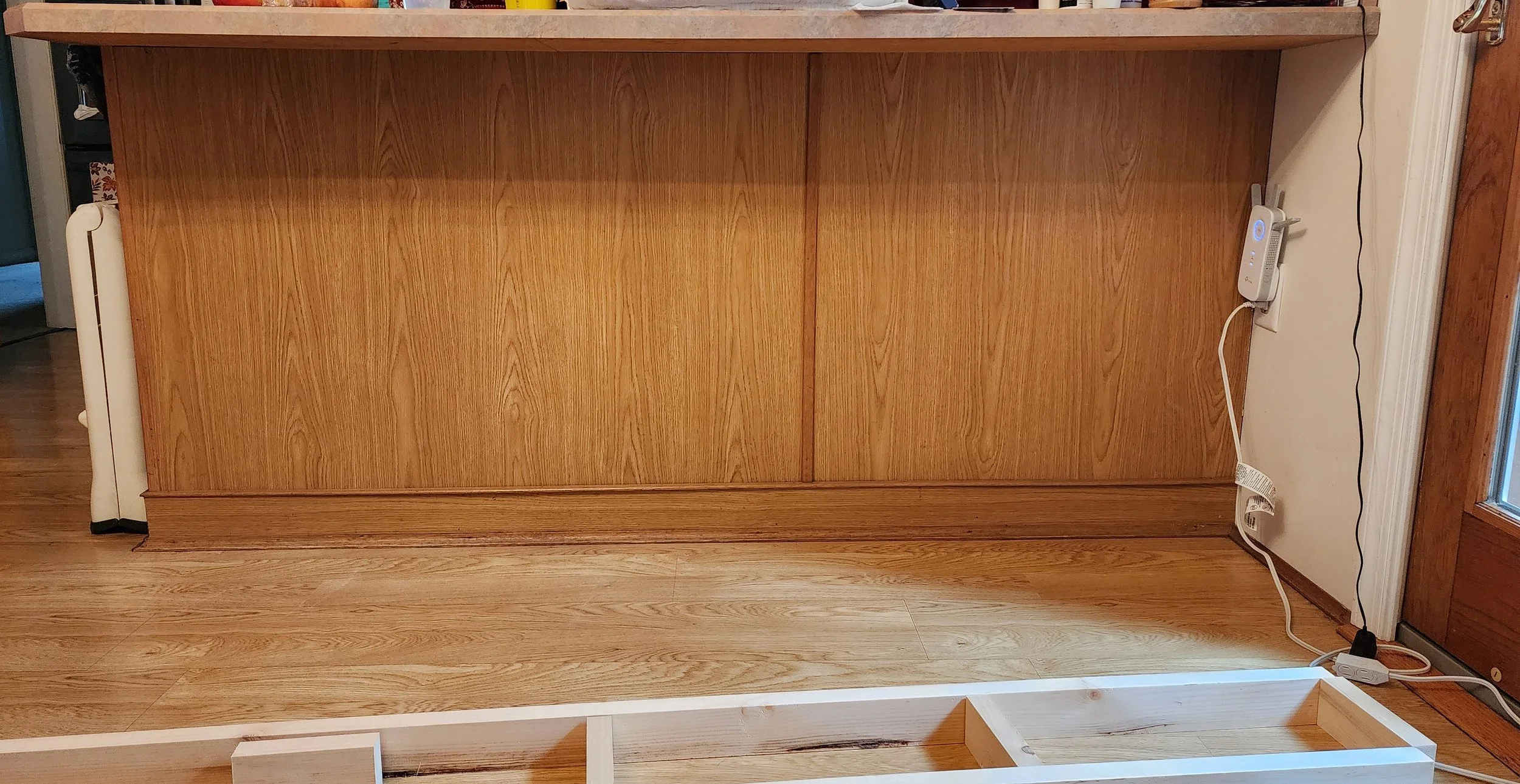
Meanwhile, there was this counter bar in her kitchen. Unused. No one sat there. The space beneath it—just... empty. Wasted.
I'd been wanting to develop my building skills further, to tackle something more ambitious than what I'd attempted before. A custom piece built entirely from my own measurements, designed to solve a specific problem in a specific space. Not inspired-by or adapted-from, but genuinely mine from concept to completion.
This felt like the convergence: a real problem, real stakes, and a real chance to discover what I could figure out on my own.
The challenge? My mother was skeptical. Understandably so—I'm not a carpenter. I didn't have professional training or years of experience. Just ambition and a rough sketch of what could work.
So I made her a promise through design: the cabinet would install in a way that could be completely reversed. If it failed, we could remove it and pretend it never happened. No permanent damage. No lasting evidence of my amateur attempt.
I drew up plans. Bought materials. Started building.
The Gathering
With the space identified, the mathematics began: What were the exact dimensions beneath that bar? How could I translate empty air into a cabinet that materialized precisely within those boundaries?
The space was long but shallow—maximizing it meant careful planning. The doors needed to stay flush with the countertop edge, never protruding beyond it. And the interior had to accommodate both my mother's dishes and some small appliances she wanted tucked away.
We pulled out stoneware pieces and kitchen gadgets, arranging them like artifacts until the cabinet's depth and shelf height revealed themselves through necessity rather than guesswork.
Dimensions captured, I ventured to the home center. Since this was my experiment to conjure, I provided the funding and gathered the elements: dimensional lumber in various sizes (2x2s, 2x4s, 1x2s), quarter-inch plywood, wood screws, wood glue, liquid nails, hinges, door handles.
Then came the tools. Most were familiar companions. But the circular saw—that remained a newfound formidable ally, a power tool that demanded respect and unwavering hands.
And then inspiration arrived unbidden: light. This would be a display cabinet, after all—why shouldn't it glow from within? There was an outlet on the wall beneath the counter, perfectly positioned. I could illuminate the stoneware like treasures in a curiosity cabinet, add a board to conceal the cords, and transform mere storage into something worth observing.
One more choice sealed the reversible nature: rather than custom-cut glass (permanent, expensive, a commitment carved in silica), I gathered larger sheets of acrylic I could shape myself. Adaptable. Removable. An inexpensive escape hatch if this experiment failed.
Paint would be the final enchantment—coordinating with the existing kitchen, making the cabinet whisper that it had always belonged.
The Making
I wanted this cabinet to echo the kitchen's existing cabinetry—that slightly recessed base that makes cabinets appear to hover. The foundation assembled readily, perhaps luring me into false confidence.
The bottom shelf came together smoothly. Then the posts for the second shelf demanded precision—even spacing while remaining invisible behind closed doors, a geometry puzzle requiring more patience than I'd summoned.
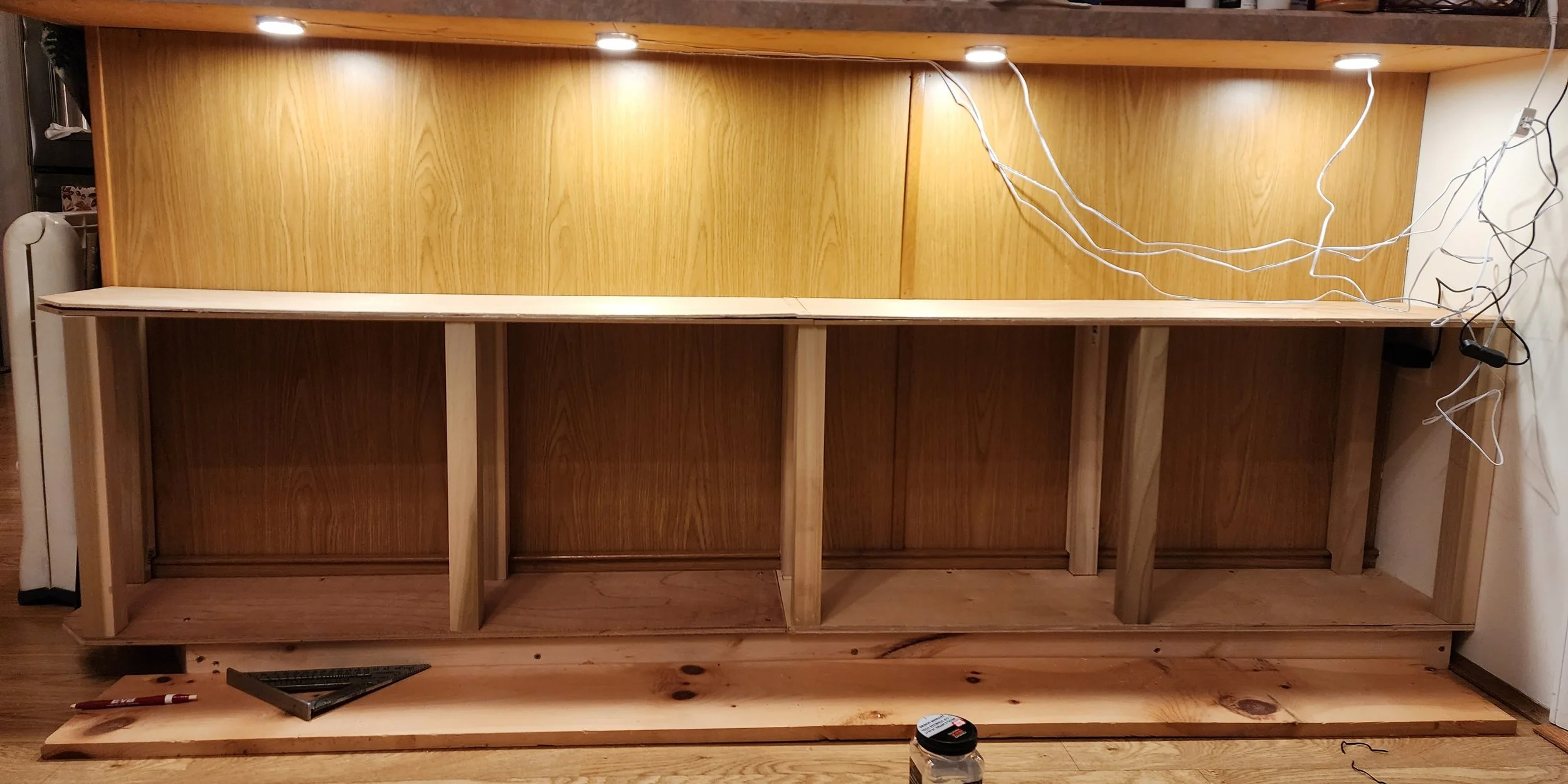
Posts secured, I added the second shelf and wove in the lighting underneath. I carved channels through two layers of quarter-inch plywood to hide the wires, which also fortified the structure for all that stoneware weight. Then lights beneath the countertop itself, conjuring that illuminated showcase I'd envisioned.
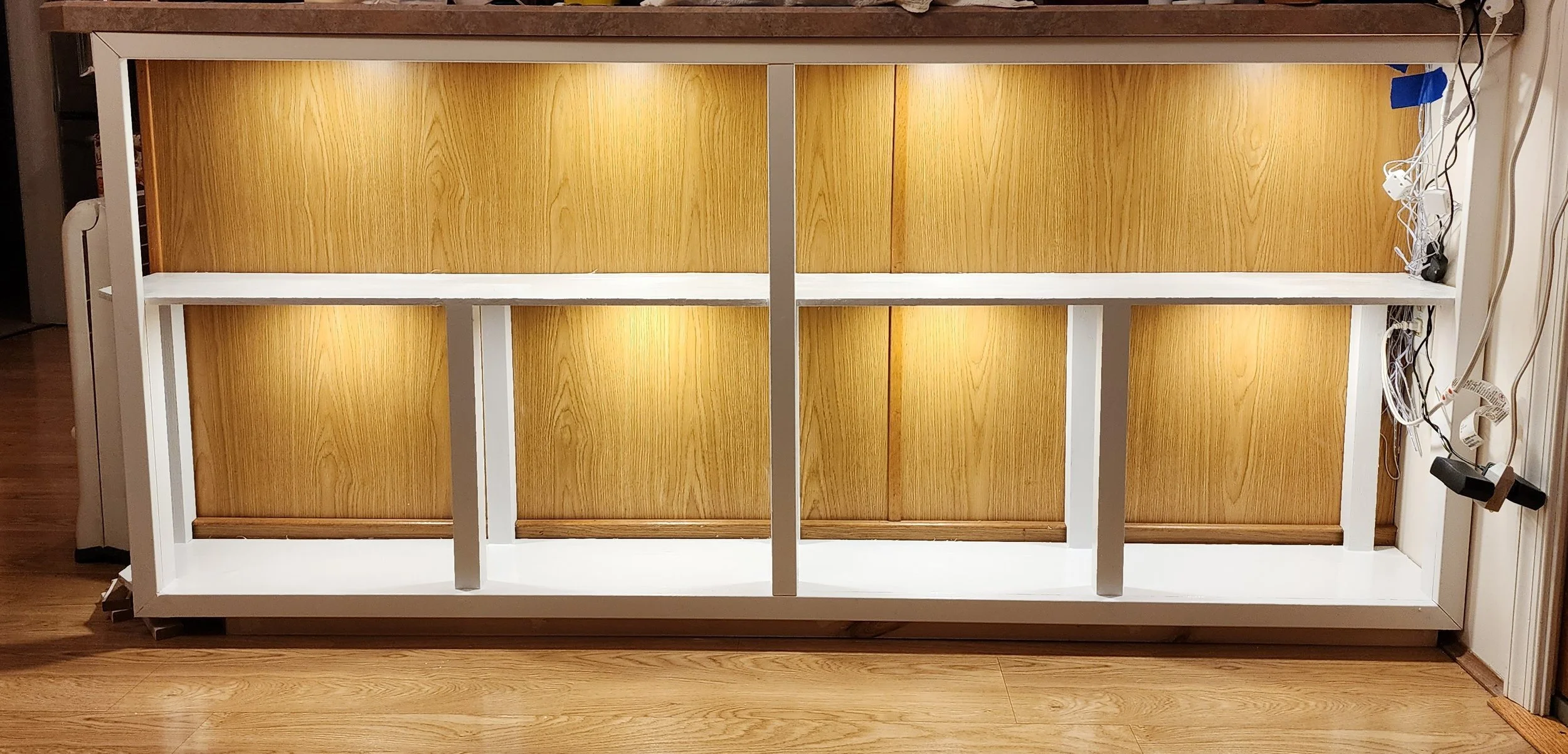
One deliberate choice: I left the back open entirely. Partly to maximize depth, but also because something told me the transparency might offer its own aesthetic.
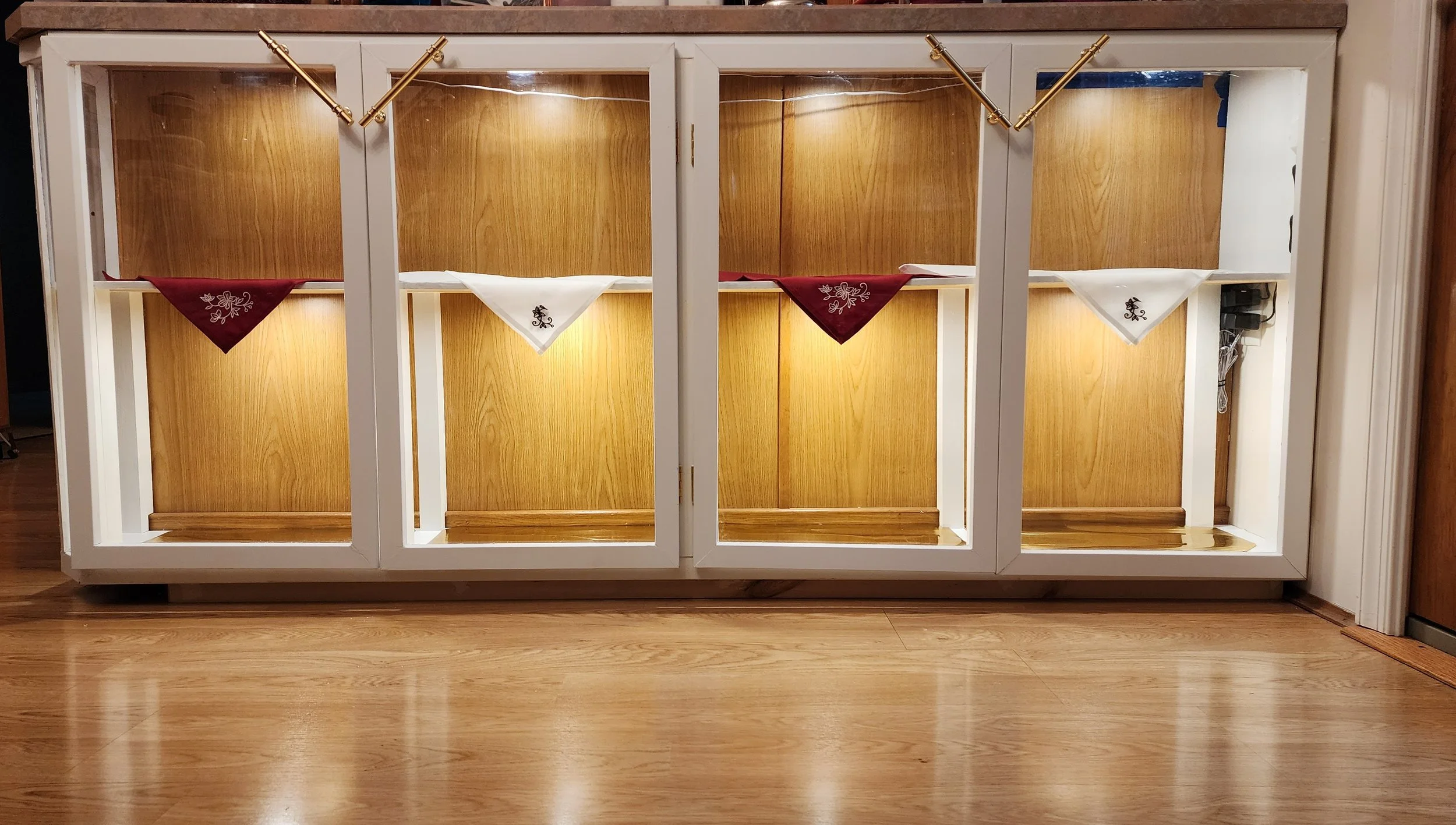
I was right. The original kitchen cabinetry shows through—its presence visible through this new structure, creating an unexpected layering effect. Depth within depth. Old and new coexisting in the same space. It adds something I hadn't predicted: the cabinet doesn't just sit against the wall, it converses with what was already there.
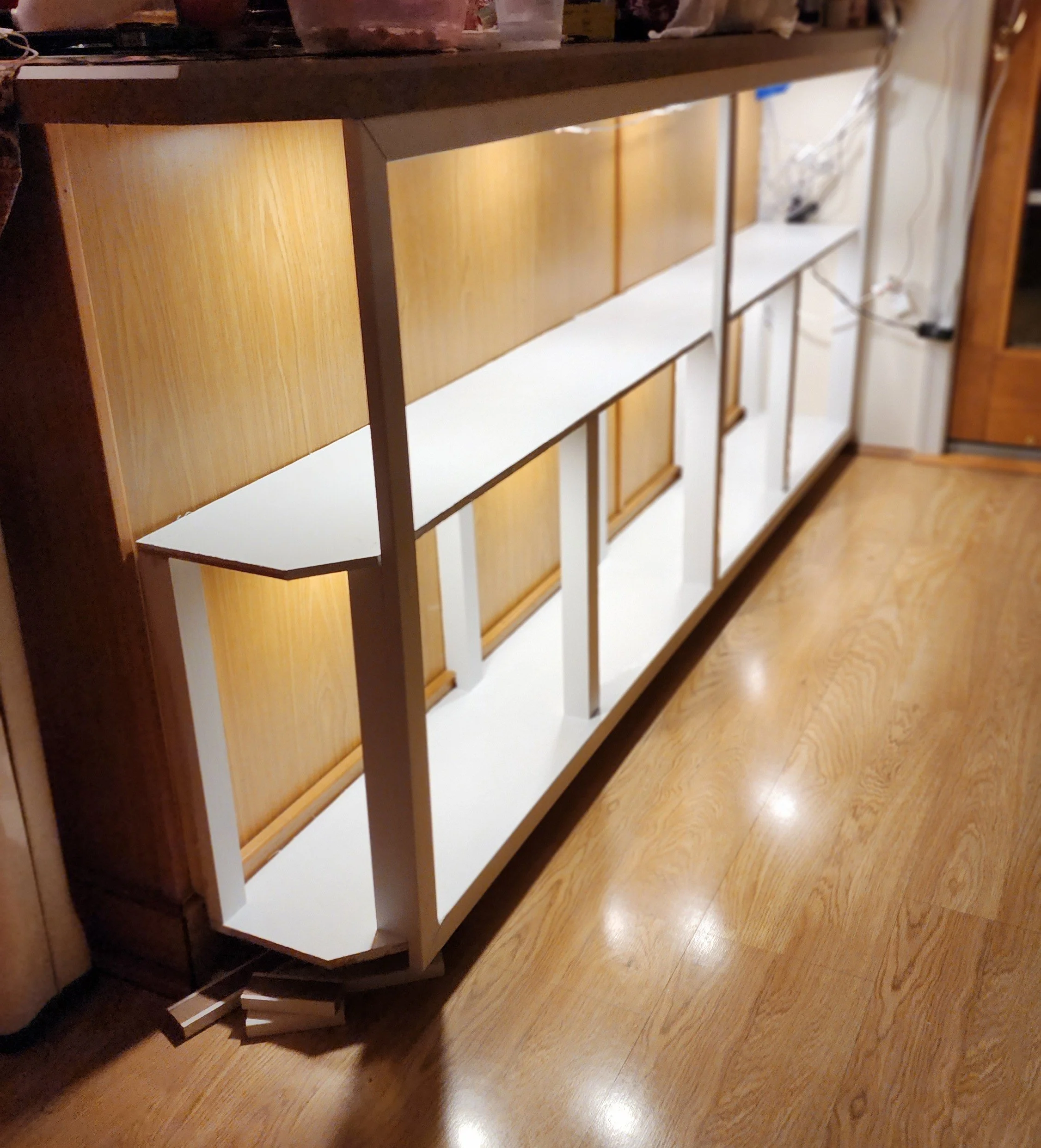
Then came my reckoning with the countertop's beveled corner.
Translating that bevel into dimensions seemed straightforward—simple geometry, careful measurement. I felt certain my calculations would manifest exactly as planned, until I began attaching the plexiglass to the exposed side.
It fits. The cabinet works. But the alignment is more offset than intended, imperfect in ways only I seem to notice. It doesn't look half bad. Just... not quite the precision I'd pictured.
The doors arrived next—four of them, arranged as two sets of French doors.
Cutting acrylic by hand with a scoring tool proved more punishing than anticipated. Each sheet required multiple passes, the blade demanding pressure and repetition. Time-consuming. Hand-aching. Tedious for pieces this substantial.
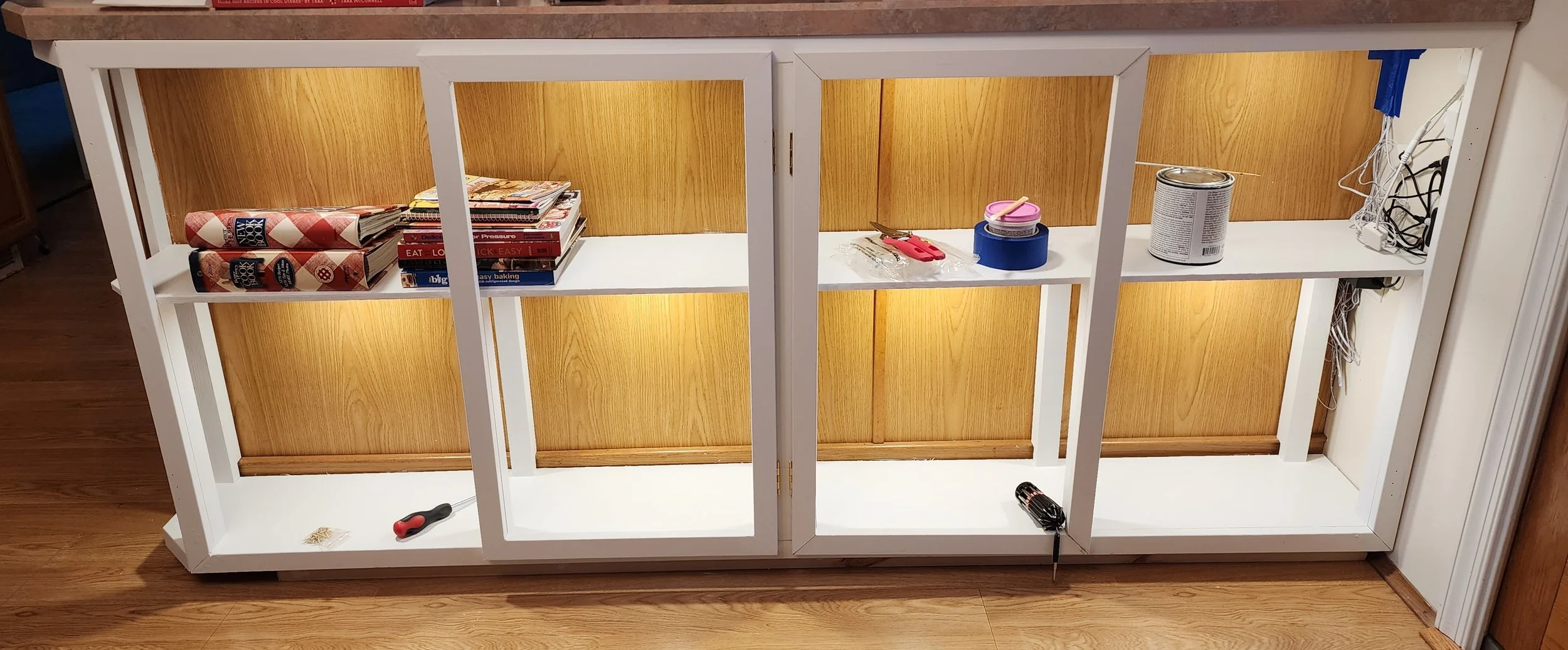
I framed each door with mitered corners, using liquid nails to marry acrylic to wood. Then the hinges—and here's where the cabinet tested my patience. Keeping doors level while driving screws felt like wrestling shadows. Every turn shifted something imperceptibly off-kilter. Attempts multiplied. Adjustments accumulated. Frustration mounted – but they leveled out.
Then I discovered an oversight: I'd forgotten door magnets entirely.
After battling hinges, adding magnets felt like mercy—simple, immediate, and satisfying.
The final charm: door handles. Finding pieces that honored my mother's aesthetic required patience, but eventually I discovered long handles with brushed gold finishes that caught light properly.
Naturally, I couldn't install them the expected vertical way.
It didn't sit right. I held them in place, considering. Vertical still felt wrong, too predictable. Then clarity arrived: diagonal. On each set of French doors, the handles meet in the middle, forming an elegant V-shape where they converge.
Simple. Unexpected. And it draws the eye exactly where I want it—toward the intentional choice, away from the hiccup with the beveled corner miscalculation.
The Reflection
Kitchen lights extinguished, cabinet lights illuminated—I stepped back to observe what the tools and I had conjured together.
Being my own harshest critic, knowing precisely where imperfections hid, this moment of genuine satisfaction caught me off guard. An afternoon's work with formidable allies I'm still learning to trust—the circular saw, the drill, the level insisting on truth—had produced something substantial.
The gratification arrived sooner than expected. While I cherish projects that demand intricate details and patient repetition, there's particular beauty in clean lines and broad surfaces that reveal themselves more quickly. Different pleasures for different making.
The diagonal hardware added visual interest as intended, but the exposed original cabinetry surprised me most. That transparency—old wood visible through new structure, layered and conversing—coupled with the hidden lighting transformed utilitarian storage into something worth observing. An unconventional space hosting an unconventional solution.
As for that beveled corner and my overconfident mathematics: next time, I'll befriend cardboard first. A template. A test piece or two. Let the prototype fail privately before committing wood and time to dimensions that exist only in imagination.
Measure twice! The tape measure tried to tell me this. I should listen to my tools more carefully.
The Resolution
I entered this project with slightly more confidence than my skill level warranted—but perhaps that audacity served me. It helped complete something more ambitious than most would recommend as a starting point, and crucially, it works.
The aesthetic isn't mine—it honors my mother's cleaner, more modern sensibilities. Setting aside my own decorative instincts and adapting to someone else's vision proved easier than anticipated. The objective clarified everything: make the cabinet disappear into its surroundings like a puzzle piece clicking into place where it always belonged.
My customer? Delighted.
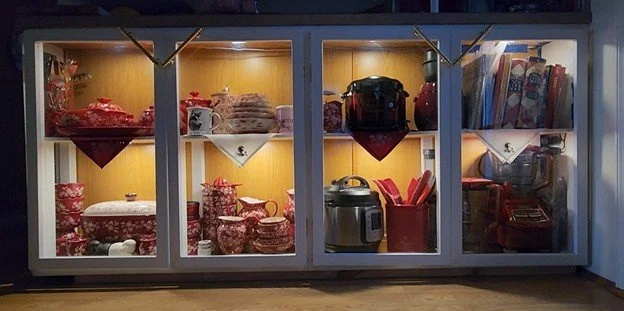
This graduated beyond refrigerator-worthy accomplishments into something she can actually use, something that displays her dish collection as it deserves—visible, accessible, celebrated rather than buried. The cabinet stands firm under all that stoneware weight without complaint, a sturdy ally performing its duty without drama.
It's stuffed but organized. Visible but unobtrusive. Unless pointed out to guests, most people don't register its presence at all—which means it succeeded exactly as intended. Blending. Belonging. Serving quietly.
And now, emboldened by this collaboration between ambition and wood and patient measuring, I've turned my attention to another empty wall in her dining area.
To me, it's crying out to become a coffee bar.
But that idea is still brewing, waiting for the right moment to manifest. The tools are ready when I am.
